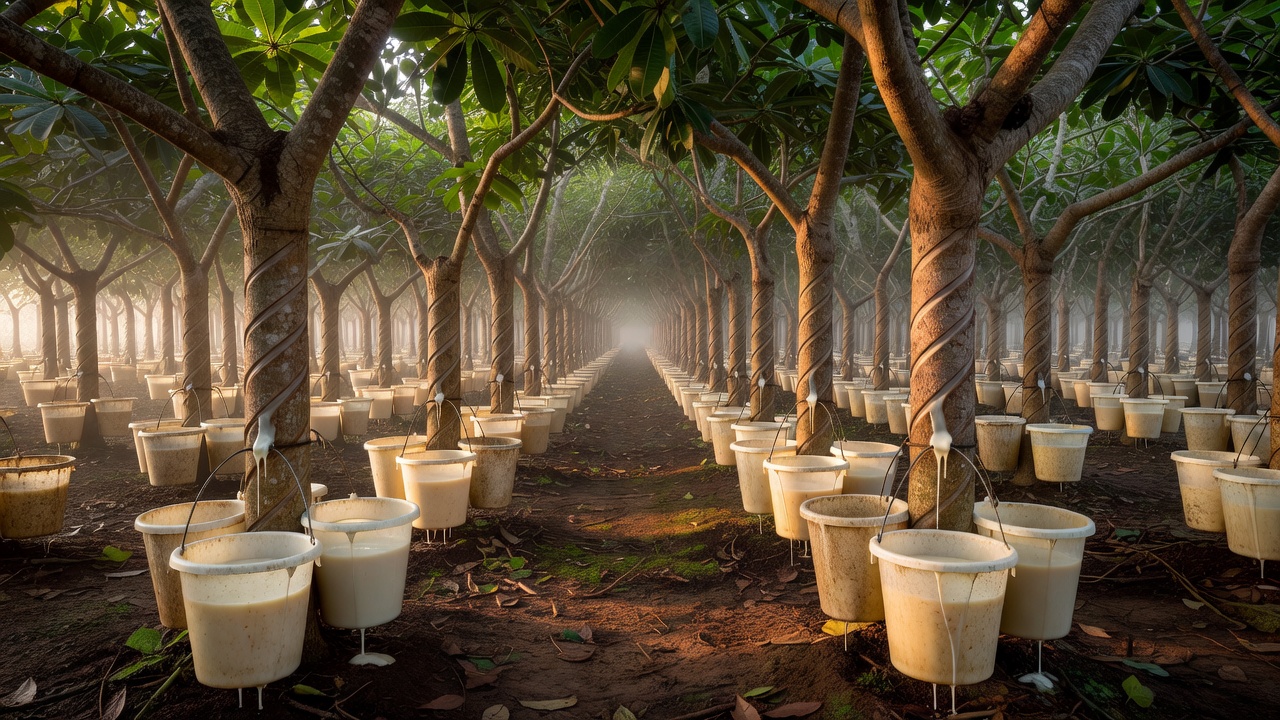
Natural Rubber (NR): The Agricultural Foundation
Natural rubber is an elastomer originally derived from a milky colloidal suspension, or latex, found in the sap of some plants. The most prominent commercial source is the Pará rubber tree (Hevea brasiliensis), native to the Amazon basin but heavily cultivated in Southeast Asia, particularly in Thailand, Indonesia, and Malaysia.
The harvesting process, known as tapping, requires precise incisions into the tree's bark. The latex drips into collection cups, a labor-intensive process that relies entirely on natural biological cycles and manual agricultural labor. Natural rubber is prized for its high tensile strength, exceptional tear resistance, and minimal heat buildup, making it indispensable for heavy-duty tires (such as those used on aircraft and large trucks).
Synthetic Polymers: Engineered for the Extreme
As industrial demands grew, and particularly during the supply chain disruptions of World War II, the chemical industry developed synthetic alternatives derived from petroleum by-products. Today, synthetic rubber accounts for over 60% of total global rubber production.
Common Synthetic Variants
- Styrene-Butadiene Rubber (SBR): The most common synthetic, heavily used in passenger car tires. It offers excellent abrasion resistance.
- Nitrile Butadiene Rubber (NBR): Engineered for exceptional resistance to oils and fuels. Found in automotive seals, hoses, and O-rings.
- Ethylene Propylene Diene Monomer (EPDM): Celebrated for its resistance to weathering, ozone, and UV rays. Widely used in roofing membranes and window seals.
- Chloroprene (Neoprene): A versatile multi-purpose elastomer that resists burning and maintains flexibility over a wide temperature range.
Comparing Natural vs. Synthetic
| Property | Natural Rubber (NR) | Synthetic Rubber (e.g., SBR/NBR) |
|---|---|---|
| Tear Strength | Excellent | Moderate to Good |
| Oil/Fuel Resistance | Poor | Excellent (specifically NBR) |
| Weather/Ozone Resistance | Poor | Excellent (specifically EPDM) |
| Cost Stability | Fluctuates (weather/crops) | Relatively stable (petrochemical) |
In modern industrial applications, engineers rarely rely on a single material. Blending natural and synthetic compounds allows manufacturers to leverage the high tensile strength of natural latex with the specialized chemical resistances of synthetics, yielding a final product perfectly tuned to its operational environment.