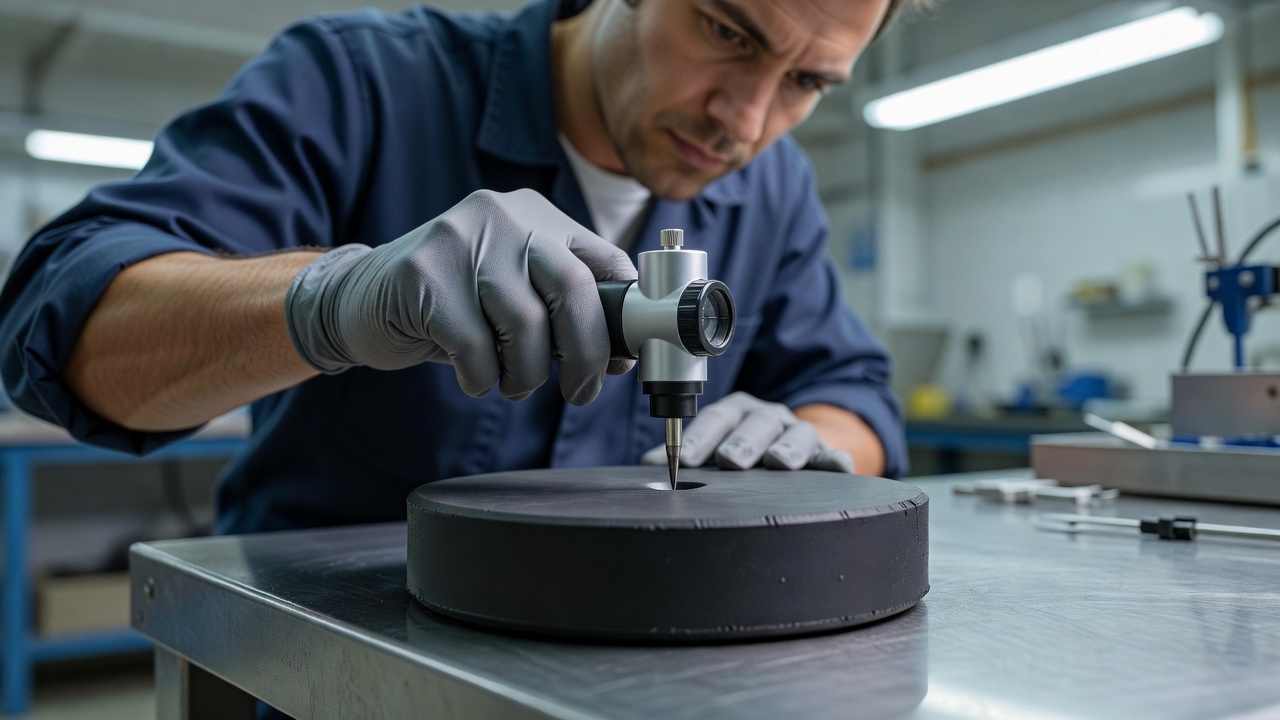
The Importance of Physical Properties
In aerospace, automotive, and medical fields, rubber failure is not an option. A gasket blowout on an oil rig or an O-ring failure on an engine can have catastrophic consequences. Therefore, every batch of rubber manufactured must undergo rigorous physical testing governed by bodies like ASTM (American Society for Testing and Materials) and ISO.
Pre-Cure Testing: The Rheometer
Before a batch of rubber is released to the molding floor, a sample is tested in a Moving Die Rheometer (MDR). This machine heats the raw compound under pressure and oscillates a die back and forth. It measures the torque required to move the die as the rubber cures in real-time. The resulting cure curve tells chemists exactly how long the factory molds need to be closed to achieve optimal cross-linking.
Post-Cure Mechanical Testing
Durometer (Hardness)
Hardness is the resistance of a material to surface indentation. Measured using a Shore A or Shore D gauge, a small steel pin is pressed into the rubber. A reading of 30 Shore A feels like a soft pencil eraser, while 90 Shore A feels like a rigid skateboard wheel.
Tensile Strength & Elongation
A cured rubber sheet is die-cut into dog-bone shaped specimens. A tensometer grips both ends and pulls the sample apart at a constant rate until it snaps. The machine records:
- Tensile Strength: The ultimate force required to break the sample (measured in MPa or PSI).
- Elongation at Break: How far the sample stretched before tearing (expressed as a percentage, e.g., 400% means it stretched four times its original length).
- Modulus: The force required to stretch the material to a specific percentage (usually 100% or 300%).